SAS Decommissioning & GenAI Code Translation
Enterprise analytics modernization using GenAI, deterministic guardrails and governed migration.
- ~500 SAS users bank-wide; ~200 in my program scope
- Claude-based SAS → Python / PySpark translation
- Guardrails, data security, validation & human approval
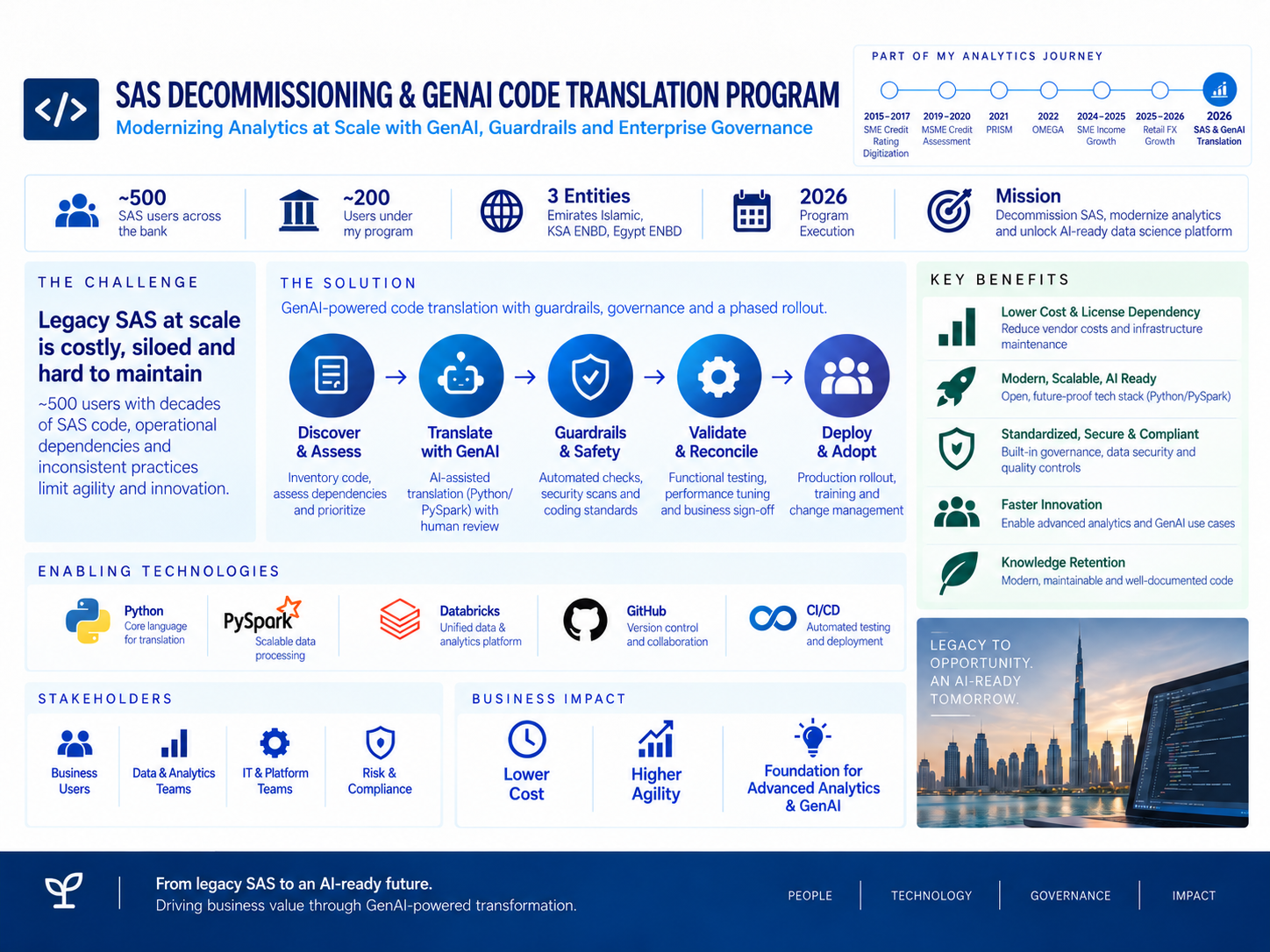
From business problem to measurable impact.
Business Problem
The legacy SAS estate contained years of analytical code and business logic, but the desktop-style setup also made centralized access control, data security, code governance and auditability harder to enforce. The challenge was to modernize without losing embedded business logic or creating new AI risks.
My Role
Program manager for roughly 200 users across Emirates Islamic, ENBD KSA and ENBD Egypt. My contribution includes LLM evaluation and selection, guardrail design, technology decisions, migration governance and controlled adoption within a wider bank-wide estate of about 500 SAS users.
Solution
A controlled migration workflow inventories SAS assets and dependencies, uses a Claude-based utility to translate SAS into Python / PySpark, inspects generated code before execution, reconciles target outputs with SAS baselines, requires expert review and then versions approved code through the modern platform lifecycle.
Technology & Methods
Claude / LLMs · Python · PySpark · Hadoop · Kedro · GitHub · MLOps / LLMOps · deterministic code guardrails · sandboxed testing · reconciliation controls
Leadership Lesson
“GenAI can accelerate enterprise modernization, but generated code should be treated as untrusted until deterministic controls, validation and human review establish equivalence and safety.”
Detailed Case Study
The infographic above is the executive summary. The full portfolio document contains the methodology, operating model, governance and implementation narrative at an externally shareable level.
View detailed PDF ↗